Project: Culture Club
Purpose: To talk about culturally relevant subjects through the lens of art
Agency: TPN (internal)
Concept and brand:
Jesús González (Sr.AD) and Kristin Pendelton (ACD/CW)
Series producers:
Jesús González (Sr.AD), Gail Obaseki (Director, Diversity, Equality and Inclusion) and Ethan Wilder (Video & Multimedia Specialist)
Host:
Jesús González (Sr.AD)
Podcast producer:
Jesús González (Sr.AD)
Culture Club started as an idea for TPN’s (Integer) new DEI initiative: what if we used art as a way to talk about the things that are sometimes difficult to talk about?
The idea was simple. Pick a cultural or social issue, find an artist whose work connects to it, and use their perspective as a starting point for a bigger conversation.
What started as an internal project quickly grew into something much bigger. Culture Club became an Instagram account, a monthly podcast, and a space where people could explore difficult subjects through art. I had the privilege of hosting the podcast, which turned out to be one of my favorite parts of the whole thing.
This became a true passion project for me. Every episode gave me the chance to meet people with completely different perspectives, hear their stories, and learn something new in the process.
The project continues to evolve, but the mission stays the same: use art to start conversations, make space for different perspectives, and maybe make the difficult stuff a little easier to talk about.
Project: Radiohead's "Spectre" Fan Edit
Purpose: Learn to edit (on Premier Pro)
Concept and Edit:
Jesús González
One of my first top-secret editing missions was also one of the most fun.
Radiohead’s “Spectre” was originally written for the 2015 Bond film but ultimately rejected, leaving the song without an official music video. So I gave myself a mission: make one.
I wanted to capture the haunting, melancholic energy of Thom Yorke’s track while paying tribute to Bond’s most iconic villain, Blofeld. I synchronized Yorke’s From the Basement performance with footage of Blofeld’s evil genius from across the Bond era, then threw in a cheeky Dr. Evil cameo at the end—because apparently one supervillain wasn't enough.
To tie everything together, I mixed in ink-in-water footage, using the swirling, abstract movement as a visual connection to the Spectre octopus logo. It gave the whole thing a darker, more cinematic feel while making the edit feel like it belonged in the Bond universe.
Every frame was a learning experience, and I definitely wouldn't call it perfect. But it was a hell of a fun mission, and hopefully one that does justice to both the melancholic beauty of the song and the legacy of Bond's most notorious villain.
Sources:
Radiohead's "Spectre"
Tom York "From the Basement" set
"Spectre"
"DIamonds Are Forever"
"You Only Live Twice"
"On Her Majesty's Secret Service"
"Austin Powers"
Project: Mandalorian armor cosplay
Purpose: To combine my love for Star Wars and art. To learn how to sculpt, paint, weather, sodder and sew.
Concept and sculptor:
Jesús González
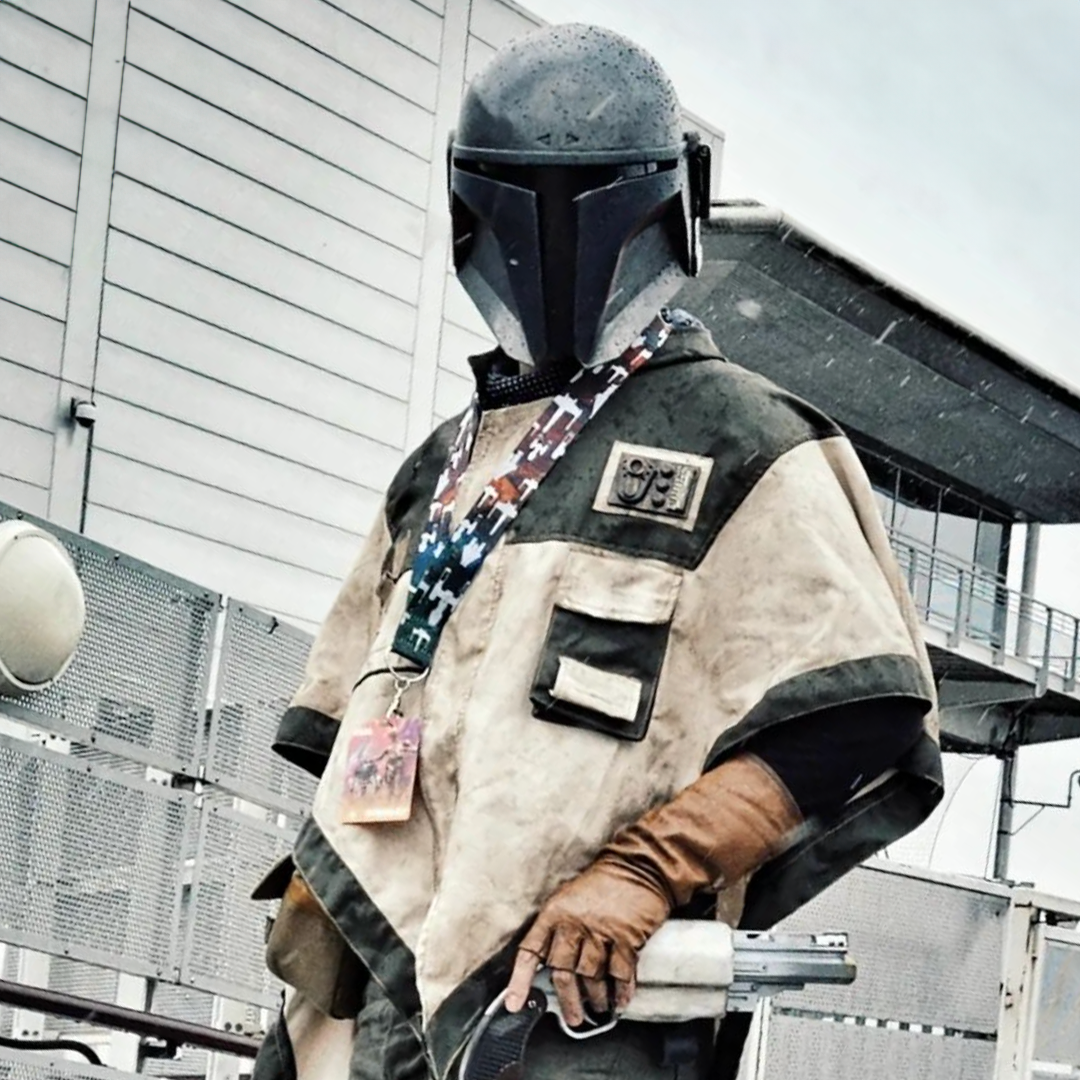
Fifteen years ago, I built my first Mandalorian armor using a bicycle helmet, plastic signs, and whatever else I could find.
It was rough. Very rough.
But it taught me something I still love about making things: you learn by building, breaking, repainting, and figuring out how to make the thing in your head actually exist.
So, fifteen years later, I decided to try again.
This time, I had access to 3D printing, better materials, and a much better understanding of craftsmanship. I kitbashed parts for the armor and weapons, experimented with painting and weathering techniques, and even dove into electronics to give the costume some extra life.
I gave myself three months and a limited budget to get it ready for Star Wars Celebration in London. Which, in hindsight, was probably not enough time.
I made plenty of mistakes along the way. The helmet alone was painted and repainted several times before I finally got the weathering where I wanted it. One of my favorite solutions ended up being a modular helmet system: magnets let me swap different props and change the entire profile of the helmet depending on the look I wanted.
And that became the bigger idea behind the project: I didn't just want to build armor. I wanted the armor to tell a story.
Cyberpunk Mode
For the cyberpunk version, I paired the armor with a jacket featuring a Teotihuacan-inspired symbol that I spray-painted myself. Faux-leather details, electronics, weathered slacks, and a hoodie underneath gave it a more futuristic, high-tech feel. I carried the white of the hoodie onto the helmet with a white brim to tie everything together.
Western Mode
The second version went in the opposite direction. I wanted a rugged, old-school bounty hunter who looked like he'd been traveling from planet to planet for years. I weathered a poncho, added Star Wars-style greebles, repurposed an old pair of boots, and layered canvas to give everything that rough-traveler feel. The helmet stayed much simpler, with just a few attachments.
The whole project became a crash course in making, problem-solving, and storytelling. Every scratch, repaint, piece of electronics, and questionable decision became part of the character.
And the convention?
Well, that's a story for another time.
Project: Internal team identity
Purpose: To create a team brand identity while honing blender, premiere pro and procreate skills.
Concept and Edit:
Jesús González
Script and Voice Over:
Ramsay Campbell
At Integer, our teams were organized into “pods.” When it was time to name ours, my writing partner and I decided that a boring team name simply wasn't going to cut it.
So we created Band of Bards.
Inspired by Dungeons & Dragons, we turned our little pod into a full-blown creative party, with a name, a backstory, a visual identity, and enough lore to make the whole thing unnecessarily elaborate.
We took visual inspiration from Arcane, built out the characters and world, and even sampled a song from Spanish folk-metal band Mägo de Oz for our animated intro video.
Was all of that necessary for an internal team?
Absolutely not.
Did we have a hell of a lot of fun making it?
Absolutely.
Because storytelling doesn't stop being fun just because the project is an internal one. Sometimes the best creative work starts with a ridiculous idea and a team willing to run with it.
Project: Favorite Vehicle Exercise
Purpose: To get to know better my co-worker
Concept and Edit:
Jesús González
As an exercise, a coworker and I interviewed each other about our ideal vehicles.
But instead of asking him what kind of car he wanted, I started somewhere else: him.
I asked about his favorite colors, shapes, movies, characters, cultural references—anything that could give me a better idea of what made him tick. The more I learned about him, the more the vehicle started to take shape.
It turns out he’s a huge sci-fi, anime, and cyberpunk fan. So I leaned all the way in.
The final video became a love letter to the things he liked, packed with references to Alien, Blade Runner, Akira, and plenty of other sci-fi movies and shows. The vehicle itself became almost secondary, it was really a visual portrait of the person I was designing it for.
It was a simple exercise, but it reinforced something I try to bring into every project: sometimes the best way to design something for someone is to stop asking what they want, and start figuring out who they are.